
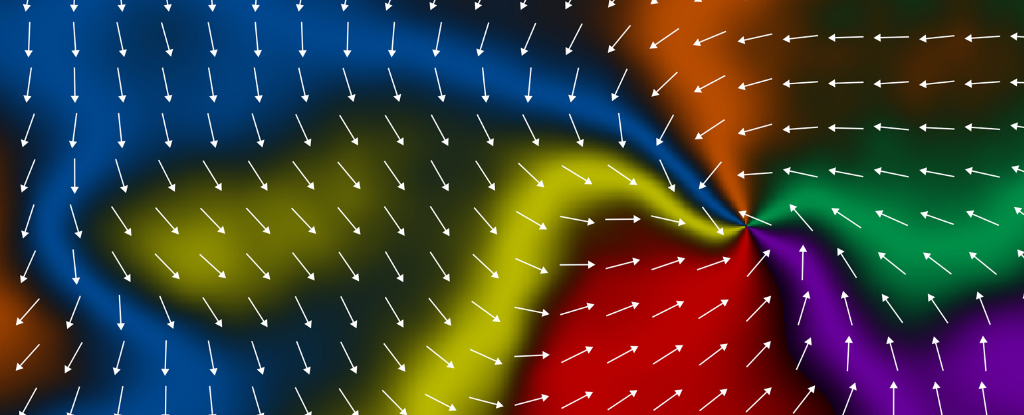
Physicists Confirm The Existence of a Third Form of Magnetism
Title: A New Era in Physics: The Confirmation of a Third Form of Magnetism
In a groundbreaking scientific advancement, physicists from Sweden have confirmed the existence of a third form of magnetism, a discovery that could revolutionize electronics and lead to significant improvements in memory storage and energy efficiency.
The research team, based at the University of Gothenburg, Sweden, was able to demonstrate control over this novel type of magnetism in a series of intricate experiments. Their findings, published in the renowned journal Nature Physics, detail a groundbreaking discovery that could reshape our understanding of magnetism and its applications.
Until now, ferromagnetism and anti-ferromagnetism were the only known forms of magnetism. Ferromagnetism, the stronger of the two, is what we commonly associate with magnets. This is the force that sticks your fridge magnet to your refrigerator, and it’s what drives the needle of a compass towards the north. Anti-ferromagnetism, on the other hand, is a more complex and weaker form of magnetism that arises from the opposing orientations of electron spins in a material.
The newly discovered third form of magnetism, called “chirality induced exchange bias,” is a phenomenon that has puzzled scientists for years. It’s a form of magnetism that, unlike the other two forms, doesn’t rely on the alignment or opposition of electron spins. Instead, it involves a unique interaction between the spins of electrons and the structure of the crystal lattice in a material, resulting in a magnetism that is more stable and resistant to temperature changes.
The team at the University of Gothenburg was able to gain control over this elusive form of magnetism through meticulous manipulation of the crystal structure of a thin film of manganese oxide. They found that by altering the crystal structure, they could control the chirality – or ‘handedness’ – of the material, thus controlling its magnetic properties.
Dr. Johan Hellsvik, one of the lead researchers on the project, said, “This is a significant breakthrough in the field of magnetism. Our discovery of a third form of magnetism opens up a whole new realm of possibilities. It’s like we’ve found a new piece of the puzzle that could change the way we understand and use magnetism.”
The potential applications of this discovery are boundless. With the ability to control this new form of magnetism, scientists could develop more efficient and powerful electronic devices. For instance, memory storage devices could be made smaller, faster, and more energy-efficient. In addition, this breakthrough could lead to advances in a range of fields, including telecommunications, medical imaging, and renewable energy.
Prof. Johan Åkerman, another leading member of the research team, emphasized the potential impact of the discovery. “The implications of our findings are immense. We could see a new generation of electronic devices that are more efficient, more powerful, and more compact. This could revolutionize everything from your smartphone to your electric car.”
This discovery, however, is just the beginning. The team at the University of Gothenburg plans to continue their research into this new form of magnetism, exploring its properties and potential applications. They hope to build on their findings and further our understanding of this fascinating phenomenon.
In conclusion, the confirmation of a third form of magnetism is an exciting leap forward for the field of physics. Not only does it add a new dimension to our understanding of magnetism, but it also paves the way for advancements in technology that could significantly improve our lives. As we continue to explore this new frontier, the possibilities seem endless.
